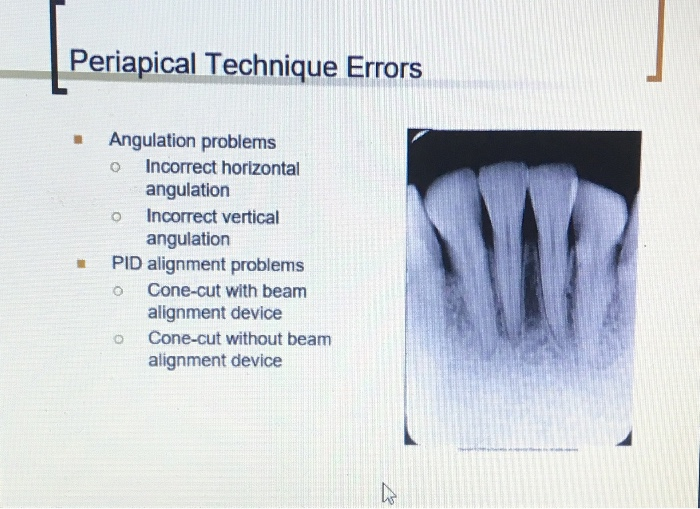
Elongation errors occur when the x-ray cone is under-angulated or too shallow causing the radiographic image to appear long and distorted. What can occur from incorrect horizontal angulation.

Exposure And Technique Errors Ppt Video Online Download
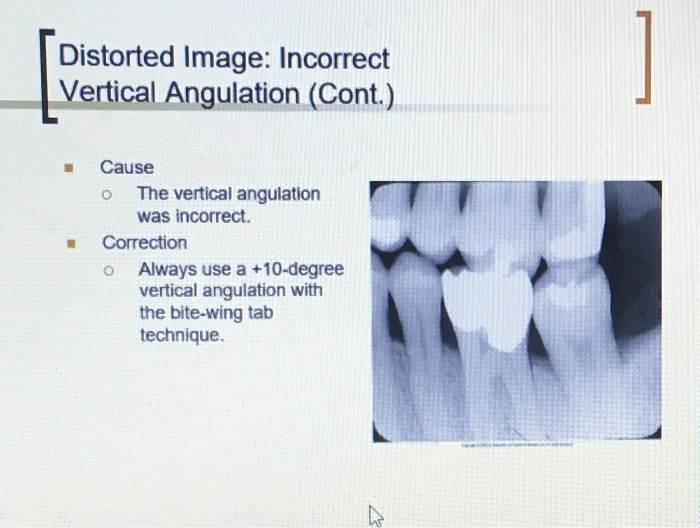
Incorrect vertical angulation errors can cause either elongation or foreshortening.

. Do all of the above. Horizontal angulation is the side to side angulation 40. Incorrect horizontal angulation of the PID results in.
Incorrect vertical angulation can result in an image that is. Either elongated or foreshortened. Insufficient vertical angulation can result in an image that is.
Foreshortening of images results from excessive vertical angulation. Vertical - elongation - vertical angulation too small - foreshortening - vertical angulation too great Horizontal - overlapping - incorrect horizontal angulation 2. Slide the film sensor along the palate to minimize the possibility of eliciting the gag reflex.
According to the guidelines for film placement the identification dot on the film is always placed. Either elongated or foreshortened. The many inherent variables can inevitably result in image distortion and reproducible views are not possible with this technique.
Proper film placemetn for bite-wing radiographs. Improper Vertical angulation can cause elongation of the images or foreshortening of the films. Too little vertical angulation results in images that are.
Incorrect horizontal angulation of the PID results in. A film with overlapped contact areas cannot be used to examine the interproximal areas of the teeth. Elongation The distortion on a radiograph that results in lengthening of the image in one dimension.
The molar bitewing image should be centered over the. What can result from an excessive vertical angulation. An incorrect vertical tube head angulation will result in foreshortening or elongation of the image while an incorrect horizontal tube head angulation will cause overlapping of the crowns and roots of teeth.
When this angulation is correct the vertical dimension of the tooth will be as realistic as possible. The tube head may be horizontal 0 when X-raying mandibular molars. Incorrect vertical angulation may cause two problems--foreshortening or elongation.
Incorrect vertical angulation can result in an image that is. Do all of the above. The image of the teeth appears smaller than normal see figure 4-5.
In the slot of the film holder. One technique for the management of the patient with a gag reflex is to. Vertical angulation differs according to the technique being used it refers to the up and down plane it can be determined in degrees marked on the outside of the tubehead 41.
Finger marks - from improper handling with hands. Position the film sensor slowly. Its defined as the misrepresentation of the shape length or width of an object.
The correct vertical angulation can usually be obtained by using the angles shown on the chart in figure 1-26. In the slot of the film holder. In all areas by using zero degree vertical angulation there was less difference between mean of radiographics and clinical measurements.
If the central ray of the x-ray beam is not centered on the film sensor a partial image will result in. Incorrect vertical angulation can result in an image that is. Distorted images - from improper alignment of the tube object or film.
In all areas radiographic data were less than clinical diameters. When taking a full mouth series it is best to start with anterior images. A wrong angulation results in a distorted.
Notice the tube head is angled downward for maxillary radiographs and usually angled upward for mandibular radiographs. Elongation is where the films appear longer than usual and foreshortening is where the films seem smaller or. Vertical Angulation is the angle in the vertical plane at which the central x-ray beam is angled during dental radiographs.
None of the above. 1 Foreshortening exists if the vertical angulation is larger than necessary. This causes the shadow of the tooth to be miscast on the film.
What horizontal angulation should be used for bitewing images. Vertical angulation is the positioning of the x-ray cone in a vertical or up-and-down position 1. None of the above.
Incorrect horizontal angulation results in images that are. What is the result of incorrect horizontal angulation. Incorrect horizontal angulation results in overlapped unopened contact areas.
Incorrect horizontal angulation of the PID results in. According to the guidelines for film placement the identification dot on the film is always placed. The image appears either shorter or longer than the actual size foreshortened or elongated images Term.
Which of the following errors can occur with the bite-wing. Incorrect horizontal angulation results in overlapped unopened contact areas. The maximum differences between invitro and radiographic findings were 3 and -2745 mm.
Incorrect vertical angulation errors can cause either elongation or foreshortening. The many inherent variables can inevitably result in image distortion and reproducible views are not possible with this technique17 An incorrect vertical tube head angulation will result in foreshortening or elongation of the image while an incorrect horizontal tube head angulation will cause overlapping of the crowns and roots of teeth7. To correct an elongated image on an x-ray view the vertical angulation needs to be increased 42.
Vertical Angulation Errors. Results in a radiographic image that is not the same length as the tooth. In adults a size ___.
Exposure Technique Errors Ch 20 Flashcards Chegg Com

Technique Errors Intraoral Imaging Basic Principles Techniques And Error Correction Continuing Education Course Dentalcare Com
Exposure Technique Errors Ch 20 Flashcards Chegg Com
Chapter 20 Exposure And Technique Errors Flashcards Quizlet




0 Comments